Part three: Get the gist – mental model building
As educators, the moment we engage in modelling, we have to see it as a chance to do something really powerful for our students. We have a chance to leave them with an expert model; a chance to make the abstract concrete and support their conceptual understanding of a complex process.
[5. Pg 40 & 41]
There is no doubt that reading comprehension is a highly complex process so of course high-quality modelling will sit right at the forefront of any reading lesson – but does it? As teachers, do we routinely plan for the moments when we need to model how our expert reading brain operates? Often, the teaching of reading comprehension is structured around asking questions after the act of comprehending has taken place missing opportunities to make the abstract process of reading concrete – the act of making meaning remains invisible to the novice reader. The rich get richer and the poor get poorer.
In Part One: Lingering with the text, it was emphasised that the the novice reader needed to be supported as they read through multiple interactions with the same text; bringing alive the often invisible intertwining of the strategies expert readers apply so effortlessly. This blog post attempts to explain how expert modelling is of course the tool we need to sharpen but what does it actually look like in a reading lesson?
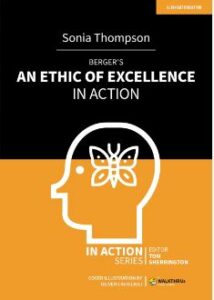
Ron Berger in his Ethic of Excellence puts forward modelling as an absolute must in his description of effective teachers, describing them as those who are aware of their expertise and of how to reveal their skills to leaners [5.]; yet the key processes behind successful readers frequently remain hidden from the novices within our classrooms.
Modelling within the context of reading instruction needs to be planned to ensure key moments are drawn upon and not missed; the experts need to know how to share the most powerful parts of the text with the novice, so they see and hear key meaning-making opportunities; and the process must be succinct yet robust.
Therefore, there is no dodging the sometimes uncomfortable truth that the teacher delivering the reading lesson needs to have read the text. This might sound obvious, but often teachers choose not to pre-read a text so they can react genuinely to the unravelling of the plot. Yet, if we blindly delivered a maths lesson without studying the content prior to its delivery we would almost definitely not be making the most of the time with the children sat in front of us and the same applies to reading lessons. Time is finite. Therefore, number one…read the text before teaching it to the children.
In the previous Blog post I wrote ‘The teacher reads and models not only how an expert reader might sound but also what a successful reader does to build an effective mental model of the text – visibly intertwining the reading strategies (lots of summarising) and framing reading success for the pupils. [3. Pg 47].‘
This essentially means the teacher needs to simulate exactly what an expert reader does [9. Pg 3]. Opportunities to model the following strategies need to be carefully, explicitly planned for:
- summarising
- predicting
- questioning
- clarifying – often through inferring
Think it out…talk out loud – call it what you like but you need to bring your expert reader into the classroom, loud and clear. The skill is integrating these strategic moments naturally and smoothly throughout the first read, because the act of understanding a text does not conveniently wait for the end of a chapter or story. [4. Pg 134].
It might sound a little like this…
(Remember as the teacher reads with expert reading fluency, the children are tracking the text to ensure they are also actively reading.)
Teacher reads: Lucy walked around the house. Inside the house everything was quiet. Her mother was putting homemade jam into pots. Her father was out at his job, playing the tuba. Lucy heard noises. The noises were coming from inside the walls. They were hustling noises and bustling noises. They were crinkling noises and crackling noises. They were sneaking, creeping, crumpling noises. Lucy knew what kinds of things make noises like that in the walls of big old houses, and she went and told her mother.
Teacher, thinks it out:
- Summarise: So what do I know so far…Lucy lives in a house with her Mum and Dad and there are strange noises coming from the walls but Lucy knows what they are. She doesn’t seem worried or scared.
- Question: But I’m wondering how is Lucy so confident that she knows what the noises are? What are those noises?
- Prediction: I think she might think they are rats?
Health Warning! You may choose to only model one of these strategies or interject them earlier on. You do not need to explicitly tell your children you are summarising, predicting etc. Knowing and responding to the children sat in front of you is your power.
Teacher continues to read: “There are wolves in the walls,” Lucy said to her mother. “I can hear them.”
“No,” said her mother. “There are no wolves in the walls. You must be hearing mice, I suppose.”
“Wolves,” said Lucy.
“I’m sure it’s not wolves,” said her mother. “For you know what they say…If the wolves come out of the walls, then it’s all over.”
“What’s all over?” asked Lucy.
“It,” said her mother. “Everybody knows that.”
Lucy picked up her pig-puppet doll, which she’d had since she was a little, little baby. “I don’t think it sounds like mice,” she said to her pig-puppet.
Teacher thinks it out:
- Summarise: Well, I wasn’t expecting that! We now know that Lucy actually thinks the noises are wolves and her mum disagrees because if it was wolves ‘it’ (whatever that is!) would be all over. We then meet a new character – Lucy’s special pig puppet which I presume is a teddy.
- Clarify: I think Lucy is worried because she is speaking to her pig-puppet. Explain clarification through inferring: Children often speak to their special teddies when they need comforting.
- Question: What does the Mum mean ‘it’ would be all over?
And so it continues. The children are hearing what an expert reader sounds like in their head. Of course, you can embellish this process in many, many ways. Jotting a summary as you go, asking the children to turn to their partner to echo the summary so far. However, you don’t want the pauses to be too long, to break the flow of the narrative and don’t forget the children will be tracking as the teacher reads so this too needs to be taken into account.
Reading so often sits in the abstract and yet if we want children to be motivated to read, it is imperative that we make visible what success looks like for the novice reader – illustrating that sometimes even expert readers need to grapple with the text. Placing high-quality, planned modelling moments at the heart of reading instruction will ensure the implicit, complexities of reading comprehension are made explicit for all, leaving no child behind.
One thought on “Part three: Get the gist – mental model building”
Hi, this is a comment.
To get started with moderating, editing, and deleting comments, please visit the Comments screen in the dashboard.
Commenter avatars come from Gravatar.