Part One: Meaning making: a complex process
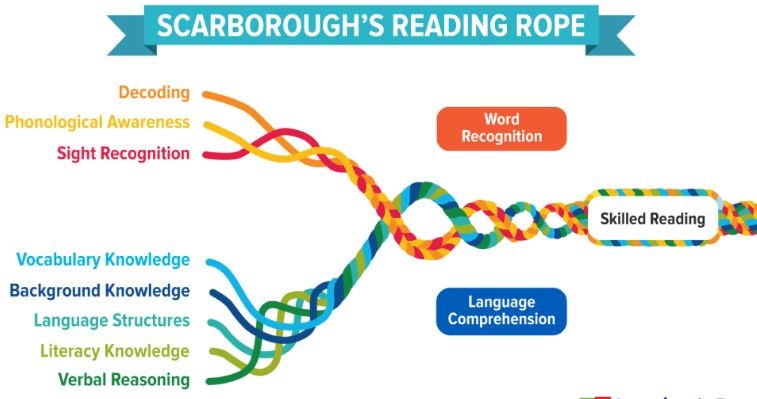
As Scarborough’s well-known reading rope image illustrates, reading with meaning is a multifaceted process. Readers who read with a deep level of meaning habitually select the right reading strand or use them simultaneously to orchestrate an overall understanding through continually building and updating their own mental model.
However, I believe that in addition to the reading rope complexities, comprehension relies heavily on the specifics of the text being read: the background knowledge for that particular text; the vocabulary in that particular text; the structure of that particular text; alongside the motivation – which doesn’t feature anywhere in many of the reading models – for reading that particular text.
Furthermore, successful comprehenders will also set their own purpose and aims of reading AND will instinctively monitor for comprehension to meet their own internal high standards of coherence – in addition to intertwining the strands, building mental models and adapting to the text structure in front of them. Is it any wonder teaching children to read, to really read, is such a challenge; why so many choose to follow acronyms to underpin the ‘how’ they teach their children or download reading comprehensions to provide the ‘what’ to teach their children to read with?
Children who remain ‘novice’ readers and who are not actually explicitly taught how experts understand the texts they read become unsuccessful comprehenders. This is not just terrible news for their secondary school experience where reading is the primary vehicle by which they learn, but more crucially, these children will repeatedly fail to understand the texts they read; reading with no meaning becomes the rule rather than the exception. These are the children who will merely crack the code with no purpose or understanding, becoming the literate illiterates.
Developing accurate mental models from texts and having high internal standards of coherence are crucial in reading with meaning, yet so often reading instruction, especially reading interventions, rely on teaching individual strategies or skills (more on this later); keep the process of intertwining the strategies needed to build effective mental models a secret; and miss opportunities to support children in gaining high-levels of coherence.
The following blogs aim to make the complex task of reading explicit, enough for all children to be successful, confident and motivated readers.
- Part Two: Lingering for success – Get the Gist, Get to Grips and Go Solo!
- Part Three: Get The Gist – mental model building
- Part Four: Fluency – what is all the fuss?
- Part Five: Get to grips – purposeful book talk
- Part Six: Vocabulary – read it, teach it or dig deep?
- Part Seven: Go solo – the need for independence
- Part Eight: Connect and wonder
- Part Nine: Precisely pitched texts
Read my blogs to find out more about each tool and to consider what it might look like in the classroom.